
Clarity in
Cardiovascular Practice
Navigate complex guidelines with confidence. We translate dense cardiology trials into actionable clinical tools, interactive algorithms, and concise CPD modules.

The Information Gap
Updated: Q4 2023
Primary care physicians and junior doctors are expected to manage increasingly complex cardiovascular morbidity, yet the volume of new guidelines published annually makes it impossible to stay current through traditional reading alone.
Pages of updated ESC/AHA guidelines published in the last 24 months.
Of non-cardiologists report low confidence in titrating GDMT for HFrEF.
Clinical Calculators
Point-of-care tools for immediate risk stratification.
CHA₂DS₂-VASc Score
Assess stroke risk in patients with non-valvular atrial fibrillation to guide anticoagulation therapy.
Stroke RiskHAS-BLED Score
Estimate 1-year risk for major bleeding in patients with AFib to weigh against anticoagulation benefits.
Bleeding RiskASCVD Risk Estimator
Calculate 10-year risk of atherosclerotic cardiovascular disease to guide statin initiation.
Primary PreventionQTc Calculator
Correct the QT interval for heart rate using Bazett, Fridericia, Framingham, and Hodges formulas.
ECG AnalysisEssential Clinical Guides

Heart Failure (HFrEF) Pathway
The historical sequential approach to GDMT is obsolete. Modern guidelines demand rapid, simultaneous initiation of the four foundational pillars. We break down the practical steps of initiating ARNI, Beta-blockers, MRA, and SGLT2i.
Read Guide →Atrial Fibrillation Management
Rate vs. Rhythm control in 2024. A comprehensive look at the CC-ABC pathway: Confirm AF, Characterize AF, Anticoagulation to avoid stroke, Better symptom management, and Comorbidity optimization.
Read Guide →Resistant Hypertension
Defining true resistance vs. pseudo-resistance. Diagnostic workup for secondary causes and the evidence-based escalation pathway for pharmacological management.
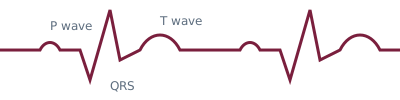
Read Guide →The Anatomy of an ECG
Understanding the electrophysiology behind the ink. A structured approach is the only defense against missing subtle ischemia.
Statin Intensity Quick Reference
| Intensity | LDL-C Reduction | Atorvastatin | Rosuvastatin |
|---|---|---|---|
| High | ≥ 50% | 40–80 mg | 20–40 mg |
| Moderate | 30–49% | 10–20 mg | 5–10 mg |
| Low | < 30% | - | - |
Source: 2018 AHA/ACC/AACVPR/AAPA/ABC/ACPM/ADA/AGS/APhA/ASPC/NLA/PCNA Guideline on the Management of Blood Cholesterol.
Demystifying the Trials
We don't just quote the guidelines; we explain the seminal trials that built them. Understand the difference between PARADIGM-HF and DAPA-HF, and why it matters for your patient sitting in front of you.
- Objective analysis of absolute vs relative risk reduction.
- NNT (Number Needed to Treat) provided for all major interventions.
- Patient profiling to identify who actually benefits based on trial inclusion criteria.

Common Clinical Pitfalls
"Normal" Troponin in Unstable Angina
A normal high-sensitivity troponin does not rule out unstable angina. UA is a clinical diagnosis based on history (rest pain, accelerating pattern). If the story is highly suspicious, the patient needs admission regardless of the lab value.
Over-relying on the ECG for Posterior MI
Standard 12-lead ECGs frequently miss isolated posterior STEMIs. Look for ST depression in V1-V3, prominent R waves, and upright T waves. If suspected, request posterior leads (V7-V9).
Stopping ACEi/ARB for Mild Creatinine Bump
An initial rise in serum creatinine of up to 30% after starting an ACEi, ARB, or ARNI is hemodynamically expected and is not an acute kidney injury requiring cessation, provided potassium remains stable.
Stay Clinically Current
Join 12,000+ clinicians receiving our monthly breakdown of practice-changing cardiology trials.
No spam. Unsubscribe at any time.